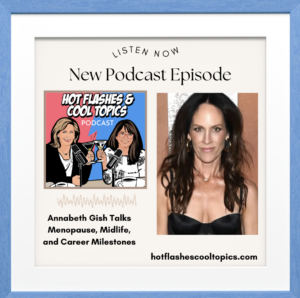
ANNABETH GISH: EPISODE LINK
TRANSCRIPT:
Colleen: Welcome back, everybody. We are thrilled to have on the show, Annabeth Gish today
welcome
Annabeth: thank you I’m so glad to be here
Colleen: oh thank you well we’re thrilled to
be talking to you because we just feel like these conversations with women over 50,
it just it resonates with so many women like it just you don’t necessarily have to
be over 50 for this to resonate and I think to that point it’s
so good that all of these conversations are happening and there’s so much more
access to the obviously the women’s health movement and menopause
always says we want the women after us to take for granted that this information is
out there because it wasn’t there for us.
Annabeth: Correct. I often say that me personally,
I didn’t have, I don’t have a map per se because my grandmother,
my maternal grandmother, my mother, and my sister all had early hysterectomies.
So I don’t know what their menopause journey would have looked like, you know,
without those surgical interventions.
And so these kind of resources are hugely important for me.
Colleen: Well, they actually, today the day we’re taping, the FDA just removed the black box
on vaginal estrogen. And basically the black box was saying, you could die if you
use this and all this fear mongering. So as of this morning, they’ve fought really
hard to get it removed and it’s finally being removed. So it’s things like that as
conversations, you know, we talk to so many experts in the world of menopause and
it’s growing. The conversation is growing and things are happening and it’s really
nice to see.
Annabeth: I feel like we’re on this wave, right, of women’s health initiatives
and with the women’s health study that was recently released and so many experts are
sharing their news that there is a caveat right though because there’s an inundation
and we have to discern what is personalized health care for women at our age with
so much information and misinformation you know it’s it’s a little overwhelming and
there is a whole capitalistic boom behind the movement too of supplements.
Bridgett: And really, a lot of the people who went to the FDA that were on the panel have
been guests on our show, and they are experts. People suchas Dr. Heather Hirsch, Dr. Kelly
Casperson, Dr. Rachel Rubin. Dr. Rachel Rubin was just on The Today Show this morning with the
announcement with the FDA, which was really great. I was showering. My
husband runs in and says “I’m taping it for you.”
I was so happy that he did that and just to see that announcement because I know
how hard they have fought, the books they’ve written, everything that they’ve done to
fight for just this one little black box label on vaginal estrogen. I mean just that
it doesn’t go it doesn’t pass through your liver and I would not
have known any of this if it weren’t for these women and these physicians really
going out there and doing that.
Annabeth: the title of this show, mine isn’t really hot flashes as much as it
is night sweats. Yes. I’ve only had one hot flash, and boy,
was it shocking. I didn’t know what was happening until my girlfriend was like, oh,
you’re having a hot flash, and I was like, okay.
But for me, my journey has much more uh debilitating at night than during the day.
I’m 54 I have two children. I pay a
lot of attention to my physical health and wellness. I do strength training, I
watch my diet, I’m primarily vegan, only in the sense of,
I mean, I do have protein occasionally meat -based, but I’m primarily vegetarian.
I had a diagnosis about six years ago of DCIS,
Ductal Carcinoma in Situ.
So breast cancer, but it was early, caught early. And so, at that time,
I really made some adjustments to my diet and to my health care.
Colleen: What were some of the biggest adjustments that you found worked for you?
Well, I stopped drinking alcohol. That was one big,
because there was an estrogen strain to my breast cancer, I really,
that was a great thing in so many ways, not just for the estrogen receptor aspect,
but just my sleep, which has also been a huge factor in my health protocols,
is trying to, trying to navigate sleep, which is so hard.
Colleen: It’s one thing that every expert in health that we have spoken to, the topic of
sleep always comes up.
Annabeth: Yep. I would say sleep and weight gain and brain fog have
been my, you know, my three things that I’ve,
like we all are dealing with. Just the body changes. it distributes weight
differently.
Again, I’ve changed my workouts in that I’ve really adopted more
strength training.
And, and more protein, but with, like, again,
I just am not a big meat eater. I’ve had to really find those things without,
again, like, overdoing it. You know I feel um
there are these like kind of
patriarchal kind of structures of like regimented things we need to do versus,
you know, a female -oriented, allowing and flowing and flowing and embodying and
empowering in a softer, more fluid way that we, that counteracts kind of didactic
Like that’s such an important piece of this is, is yes, we can right brain it to
Hell. We can try to fix it and solve it. But then we also have to allow for this
really beautiful aspect of femininity, which is intuition,
knowing ourselves, slowing down. You know how this hustle culture is.
Bridgett: if we have the information, we know what is going to be working for us. So I’m
quoting Colleen.
Colleen: Well, thank you. I feel special. I’m getting quoted in front of
myself.
Bridgett: But I mean, but the point is, we have to have options. Women have options.
Colleen: And at this stage of life, we know that if we eat a certain thing right before we
go to bed, we’re not going to sleep. We’re not going to feel good the next day.
We’re going to have a hot flash or a night sweat.
So we’re very intuitive, like you were saying. We get it. But give us the options
to help us and we’ll figure out what works best for us. I think that’s important.
Annabeth: It was funny. I was driving this morning to get a cup of coffee, which is I won’t
ever give up coffee. That’s my like lifeblood.
But I was thinking, oh, I need to outsource for that. I need to ask somebody. And
then I was like, no, Annabeth,
stop.
Now, you know, my children, one is in college, one is a junior in high school,
my sons. And the caretaking aspect is changed. And I can,
I can kind of listen to myself a little bit. I can take care of myself instead of
taking care of other people so much, which I love to do, but there’s a balance,
a nice balance that gets to come in now, which is, what do I want to do? What do
I want to do? What do I? You know, and I don’t mean to sound like I’m not mad
at those responsibilities that I’ve like chosen because I love being a mother and I
love taking care of people. But there is an element that is like, I
don’t have to do so much of that anymore.
Bridgett: Yeah. We hear that so much and we feel
it so much because you’ve been used to doing that for so long and then you start
to have this time for yourself and then you start to think, I don’t have to please
all these people that I’ve had to please for so long. And it really is great.
Colleen: And it’s okay to make yourself a priority. That doesn’t put anybody else further down
the list. You’re just putting yourself further up. It’s okay for you to consider
what your wants are. And as estrogen leaves your body,
like nothing’s bleeding out of us we can right pretty amazing it’s very visual it
is something that you can actually visualize.
Bridgett: and say, okay it’s giving yourself
permission and for some reason we never thought we had. I guess permission may not
the best word ,but it’s we never stopped to think about our wants because we were
thinking of what’s best for our kids what’s best for our husbands our
partners what’s best for our career.
Annabeth: yes and that quiet.
That makes me emotional just to listen to you say that and describe that because it
is such a, it’s what I would think of as grace, right? That we so rarely allow
ourselves, you know, just some grace and acceptance.
Colleen: Do you find that you talk
about, because we always say, you know, we talk about it with our girlfriends the
most, but do you find these conversations happening more with some of your close
friends?
Annabeth: Oh, yes. You know, and I think that’s one of the best things,
Even though I have a core group of girlfriends, women friends who are just sustenance,
you know? It’s massively important.
Bridgett: And that sense of community, it just leads to
healthy longevity. I mean, that’s one of the biggest parts about longevity. And
Colleen and I always talk about healthy longevity. Like if you’re not healthy,
it’s going to be really a difficult longevity. So trying to stay healthy within
that. But community is so important.
Annabeth: Yes, I think too.
There’s nothing like sitting with a circle of girlfriends and, but not to dismiss,
I mean, I have two sons and I have a very in tune husband and partner who,
you know, is also part of these conversations. It’s just the nuance of change,
you know, and just being aware of it and doing it together.
Bridgett: Right. that’s so important too that the men come along and that they’re learning so your sons, are they
really learning from you for that?
Annabeth: That’ll be yeah yes they see my book shelf
you know or my bedside table which has all How to Menopause, The Pause, all these
things you know like these just the resources that are, you
know, I’m not crazy, this is real
Colleen: Do you find the acting opportunities changing with this time of life?
Annabeth: just the fact that
a few percentage of actors, male or female who really get to choose.
You know, I mean,
so much of what we do now is auditioning, and there’s a lot of great material,
which is amazing, and I do think there’s a better,
just a deeper amount of quality roles examining women in real life these days.
You know, it’s more authentic and honest. But it’s competitive, you know
and the industry is in a very strange time.
So choice is, you know, we don’t always get to be precisely (saying),
you know, I want to do that.
But I will say being an actress who has, I’ve been doing this for a long time,
like, I mean, my first film was when I was 13 and I’m 54 now.
So it’s a long time and, and I’m so grateful for an enduring career and resilience.
Yes, it changes. You know, I am still very ambitious, but I am, I’m less aggressively hustling.
You know, I’m getting quiet with some of that, with what I really want
to participate in putting forth.
It was my choice to really be here for my sons and so that kind of restricts how where I didn’t want to go.
I didn’t want to go to Toronto for a series or something like that and now that’s opening up a little but now that they’re getting their independence,(she can choose more). It’s such
funny (thing), this career. It doesn’t let you go from A to B to c to D, you really kind of
like, it’s an erratic journey.
Bridgett: Not linear.
Annabeth: Yeah, at all. Not linear, correct.
Bridgett: And, you know, you’ve done some really, I mean, you’ve played
the gamut of all kinds of characters, that there was the Jennifer Dulos story.
Annabeth: Yeah. That one.
Bridgett: How emotionally hard was that? Because, you know, that story,
just as, if you want to read, you could talk about the story a little bit.
Annabeth: Oh, sure. Yeah. A few years ago, I played Jennifer Dulos in the story of her life for
a lifetime show called Gone Mom. And boy, it affected me deeply on so many levels.
It was, it’s the story of Jennifer Dulos. She’s a woman who was murdered by her
husband and they still have not found the body. And she had five children and just
this crazy story of domestic violence and tragic.
There was a Jennifer’s Law that was implemented after her missing and,
you know, like they still haven’t found her, but about domestic violence laws in
Connecticut. And but yes, that that story in particular really affected me because,
I mean,
that certain roles do kind of leave you with a little piece of them after they’re
done.
Colleen: That must, I mean, that must be really incredible to have the ability or the
options to even explore those roles.
Annabeth: It’s the gift of it, truly.
For my own humanity and sense of self and whatnot, I absolutely every role I play,
I take a piece of and they’re integrated into me psychologically and have been
affected.
And that I get to do that for a living is, I mean, I’m such a lover of cinema
and what theater and acting can do and how it can affect change in a very
different way. But on the emotional scale, it really can change people.
Colleen: Have you
found that now that they’re streaming and so many other options, that there is an
opening for more roles for women of our demographic? Yes. Yes,
yes, yes, yes, and no.
Colleen: I love that. Yes, yes, yes, yes, and no.
Annabeth: It’s always, don’t you find that it’s
like yes and or yes but? Yes, right. I,
you know, the streaming,
the streaming initiative or whatever you want to call it has really changed the
industry.
And, you know, the algorithms or whatever, who they hire, it’s a lot of
the same people playing the same roles. So again, it’s restricted availability of
roles in the sense, you know, it’s usually like, and I think Nicole Kidman is an
incredible actress, but she is a bankable entity and so she works a lot because the
streaming service economically needs a bankable person you know so to that end, yes
there are more roles but they’re being played by the same people and so I
think what’s going to happen is this the whole independent market is going to find
an avenue elsewhere you know to really kind of come up and bring smaller
stories and connection is going to be our savior is what I think.
Bridgett: I did see that you C. Thomas Howell filmed the movie Ride in the Nashville area. Was that independent
as well?
Annabeth: That was a wonderful independent film. It’s called Ride. And
I think it’s playing on Amazon, it’s a cowboy genre, Western.
But, but, yeah, again, I get to play a sheriff, a woman, a mother, kind of with
this conflict of, what do you choose? Loyalty to your family or your job.
But I loved it, I love filming.
Colleen: Oh, that’s great. That’s making me think of
Sons of Anarchy, which is one of my favorite series.
Annabeth: Oh, yeah. I love Sons of Anarchy.
Colleen: You were so good in that. I talk about how that came out of nowhere, and I just
loved that season, working with Katie Segall and just entering that franchise was a
gift, you know, and to play a badass, too, like a corrupt cop oh man,
Bridgett: I mean that
has to be I think that has to be really fun to play a character like that.
Annabeth: it was and it’s funny because my one of my sons was like “I’m going to watch it.
We were laughing and saying maybe don’t watch
the last season with me in it because what 18 year old wants to see their mom
having sex on a cop car right?
Bridgett: No, no, no. Yeah, yeah,
yeah.
Colleen: How have they reacted to your career? Has there ever been a
point where they are like, “mom, please, my friends were like?”
Annabeth: You know, no, oddly enough,
I mean, I think that they’re not really, I’m mom to them.
And they really relate to me as mom. And yes, they know that I’m an actress and
sometimes they’ll go to events with me or whatnot. My husband is also in the
industry, so they know it.
You’re Mom and you’re in so many roles that they’re probably like okay skip that okay yeah
yeah comes with “a be careful what you’re watching.”
Colleen: right, so you have one who’s a
junior and you have one in college pretty soon you’re going to be an empty nester
how do you feel about that, how you know we are both empty nesters now. Bridgett & I. With the pandemic, got them back for a little while and then they left
again. How are you getting yourself ready for that empty nest? Are you looking
forward to it? Or are you hesitant?
Annabeth: It’s liberating and devastating. And I’ve had a bit of a little
rough window because in August, the same month,
these three things happened. And my…
generation where I am, you know, launching my children and also taking care of my
elderly parents.
So talk about grief.
Colleen: We can relate. It’s a component of this part of our lives,
you know?
Annabeth: yeah, that’s been hard really hard. It is emotionally, extremely
Draining.
Colleen: I have a mom who has dementia so i get it. It’s caring for an aging
parent and I’m very sorry for the loss of your dad because that’s we’ve both lost
our dads.
Annabeth: well offline we can talk about coping strategy. This
just happened six weeks ago.
Bridgett: oh my goodness, oh that’s fresh, that’s very fresh
Annabeth: yes and so in the
these roles, mother and daughter and caretaker,
is also, again, to use those two paradoxical words,
it’s devastating and liberating at the same time.
Bridgett: Absolutely. And grief just,
it will just get you. You won’t even expect it. And it just gets you. We did have
a really great grief counselor, David Kessler, on a few months ago.
Colleen: He was a part of the five stages of grief.
Bridgett: my mother passed away the year before my youngest, her senior year of high school.
So my mother passed away that summer. And then the next year, my daughter goes to
college. My son was already in college. And we were moving. So we were in the
process of moving. And so my husband was traveling or starting the new job. So I
was home alone. And it was so weird. And it took me a while to get over.
Colleen knows. Like we moved here. I met you. It took me a while to really. It
took me a while to get used to the
changing.
Colleen: I’ve always heard to find something to look forward to. It could be a weekend away with your husband. Just have something, you
could start something you always wanted to do. Maybe you always wanted to crochet.
Maybe you always wanted to start walking. Have something to look forward to
That is just for you. Because you’re going to need that.
Annabeth: To that end, I do feel like, even though I’ve been acting since I was 13 for 40 years,
I’ve been doing this, I also feel it could just be the beginning.
There is a certain newness in this chapter that is exciting
and exhilarating. I was going to make those one word. Exciting, exhilarating.
I like that word though.” Exhiting” would be a great for you. “Exhiting” may be the
title of this episode. “Exhiting.” It’s very very exhiting!
Colleen: maybe you can travel now to different, you know, locations
that you didn’t take on before. I mean, there’s definitely something.
Annabeth: It’s okay too.
You know, people tend to forget that’s okay to feel two emotions at the same time.
You can feel grief and feel joy. It’s like you don’t have to choose. Your, your
body knows how to absorb them both. So it’s okay, you know. It’s not yes and.
But also, what an experience, you know, resilience in them.
It’s still a collective kind of trauma that we all have sustained here
in Los Angeles for sure.
Colleen: And I feel bad for kids because
some of them are into the politics, but they don’t know any different. Like, they
think this is normal. And that makes me so sad for them because it’s not.
Annabeth: I think all of our nervous systems are really fried.
Bridgett: like you said, our children, You know, my children
were young when 9 -11 happened. Right. And then all of these other things politically
are happening. And I’m thinking, oh, my gosh, I don’t recall that maybe I was too
young and it didn’t affect me. But I was born during the Vietnam War. I don’t
remember that as well. But I do tell them, I said, I do not remember things being
so divisive when I was younger as they are for you all.
Annabeth: Well, I think categorically, you know, I mean,
history.
and on social media. But still, it’s just every generation just, it seems like more energy is being sucked out.
Colleen: Yeah. And I hope they find ways to kind of recharge and maybe turn off. Maybe this
will be the time where they’re like, you know what? I don’t want to be on TikTok.
I don’t want to follow people on this. And that would be great to just kind of
put the phone down for a little.
Annabeth: Put the phone down.
Bridgett: Yeah. That happened for me a few weeks ago. My husband and I went to see Paul McCartney.
Annabeth: That’s incredible.
Bridgett: And he was so good. And I remember I was
like, I am going to be in this moment right now. And it was so wonderful.
And it just, it was like you get these little spurts of feelings where everybody’s
on the same page for just a minute.
Annabeth: It’s called hope. Hope.
Bridgett: And that’s what I
felt. That’s right. Hope. Yeah. That is what it felt
like was hope and I remember after the 2016 election, I was so down. And the first time I felt some hope after
November of 2016, was during the eclipse of 2017
for that day and I remember thinking oh I haven’t felt this good and so long what
what’s going on? You know it’s sad because in the past, I felt like
that all the time And now it’s just the energy suckers are out.
Colleen: And that’s
what we call them the energy suckers. Vampires.
Annabeth: I do think back to that, my comment
about like kind of even with cinema and independent films and grassroots, I feel
like that will be the antidote culturally too for all of us is just to, you know,
nature. Like getting back to things that are simple because everything is so
complicated. Even my, you know,
we definitely have phone use in our house and whatever. There’s all of
that happening. It’s not like we put our phones away at dinner. Like I wish I
could say we did. We don’t. We don’t. We don’t. But I do find it really like we’ll go
for a hike together or we’ll do things that just go offline. And I think that is
an absolute key to all of our sanity somehow,
Colleen: you know, just I agree with that. Absolutely.
Annabeth: And I think it’s just for their
health, too, mental health, because their mental health has never been a bigger issue
either.
Colleen: Yeah. So, but so not to pivot, but we’re going to pivot. Let’s pivot.
Let’s pivot. What are you looking forward to now? Do you have some things coming up
that you’re just really excited for 2026 to do or be in?
Annabeth: Yeah. You know, I’m in writing. I’m really excited about that.
Colleen: You’re going to have to come back and tell us about when you write something to
share it with us because this has been such a wonderful conversation. Thank you so
much.
Annabeth: Thank you.
Colleen: Oh, please. It was our pleasure and please come back anytime.