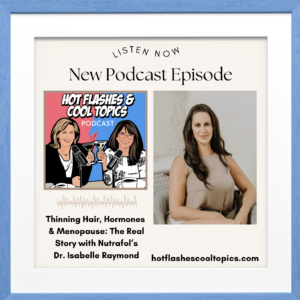
EPISODE: LINK
NUTRAFOL: LINK
TRANSCRIPTS:
Colleen: Welcome back to Hot
flashes and cool topics. Today we’re going to talk about a topic that a lot of
women get in touch with us about. And that is the effects of their hair during
menopause, postmenopause and perimenopause. And so we brought on an expert, Dr. Isabelle Raymond.
Welcome to the show.
Dr. Raymond: Thank you for having me.
Colleen: Well, we appreciate your time because
we do hear from a lot of women who feel like their hair is thinning. It’s changing
texture. There’s so many elements to when your body’s changing, so is your hair.
So I wanted to kind of start at the beginning. Can you talk about the phases, the
three phases of hair, where growth and you have the technical terms of antigen and
the other two, but can you talk about those?
Dr. Raymond: Yes, absolutely. I think it is the
base to be able to understand what happens to your hair throughout your life,
actually. So antigen phase is that
growing phase. And that phase is where your hair is growing, right? And that can
last from two to seven years depending on your genetics. So some people can grow
hair very long because they’re in that antigen phase for a long time. And then from
the antigen phase, you have the catagen phase, which is kind of like a resting
spot, right? So it’s pausing. The follicle is detaching from the bulb and it’s going
to be shedding soon. And that’s about two to three weeks. So it’s like a layover,
if you will, between flights. And then you get into your telogen phase, which is
the shedding phase. And that can last about three months. So that phase is a little
bit longer. And so not every hair follicle is in the same phase at the same time,
right? Because we’re not all losing our hair at the same time. And so it is normal
to be in a shedding phase, to have about 10 % of your hair and shedding phase,
about 90%, 85 to 90 % in that growing phase. And so that’s how we know that’s a
normal cycle. And again, because you have this two to seven years in that growing
phase, the idea we want to stay in that phase to grow our hair. But we
also want the shedding phase because from a shedding phase, then you have a new
hair that is growing from that follicle. And so on into the next. So we also have
that exogen, if you will, that sometimes we call the fourth stage, the exogen phase
when there’s a new growth. So that is a normal stage. And when we have started
going through hormonal issues or diet and lifestyle, all those things can really
affect how we enter or stay in one of those phases, which would explain hair
growing longer or thinning hair because we’re shedding more.
Bridgett: Yeah.
And then that will explain like why some people, like you said, it gets really long
and some can never get their hair past a certain point. And so women like us now,
menopause, all of us, postmenopausal, maybe, maybe I don’t know about you. But this
time of life, so many things are happening to us. If we’re perimenopausal,
menopausal, postmenopausal, already things are happened mentally to us,
things, changes are happening. And then our hair. And I know that hair is not
necessarily essential to live, but mentally it can really have a really strong
effect. Can you talk about that?
Dr. Raymond: It can. To me, just that insults injury to
everything you’re going through, you know, now this, you know. But I think, you
know, what we are trying to really shed light on is the point that it can’t
happen, right? So we have estrogen receptors throughout our bodies. It’s not just our
reproductive organs who are going through changes of, you know, through perimenopause
is just wonderful roller coaster that, you know, I’m going through right now. And
everything, you know, organs can respond differently based on, you know, the
receptors, et cetera, and how we have estrogen. And so during perimenopause, as we
go through all this zone, you know, zone of chaos, it’s been called, havoc, you
know, just, it’s a fun time, really. And so your hair follicle goes through that
too, because we have estrogen receptors on our follicles. And so it’s not surprising
that every organ is responding differently through this time. But if we don’t know
about it, then it can be surprising because you’re like, what is wrong and why is
this happening to my hair too? So when we understand the science and really the
background of biology, basically, of hair, it makes sense. And then we know what we
can do to kind of maybe help it stay in the antigen phase or feed it in a way
that will mitigate the effects of that roller coaster.
Colleen: And I think it’s interesting
because, obviously, we’ve been on hormonal journeys since we’ve gotten our periods and
it’s up and down. And a lot of women will talk about how when they’re pregnant,
their hair has never been more beautiful and their nails have never been more, you
know, long and never been longer. But for some reason, we don’t think about,
oh, well, when all of these hormones start to fade, it’s going to affect our hair
as well. Why does it seem like we get surprised? We’re not surprised when we lose
hair after we give birth, but we seem surprised when our estrogen levels start to
decrease.
Dr. Raymond: Yeah, well, I think that’s two things. A, because people have been talking
about it, women have been talking about it. And so I think we kind of knew going
into it if we do have a biological child that we would go through it. So it’s not
a surprise because I think people have talked about it. I don’t think people have
talked about hair changes throughout menopause, but we don’t want to talk about
menopause to begin with, right? So it’s not surprising that, you know, I knew about
a little bit about pregnancy periods, right? When you’re, you know, you know it’s
coming. Do you know all the details, though? Not really. Pregnancy. You have a
little bit of information, but until you were pregnant, no one seems to want to
tell you what you’re going to go through, you know, during and after, and menopause
wasn’t even mentioned. So I think now we’re just looking at the correlations and
really opening the dialogue, which allows us to have these conversations to not be
surprised when these changes happen. But to your point, when you’re pregnant,
you’re in the antigen phase because of all of these, you know, the estrogen and
that wonderful balance that is that’s keeping your body fed with those hormones.
And then when you have that drop postpartum, it can, it can wreak havoc, but
there’s also, um, there’s stress and other factors that can really contribute,
contribute to it. So the change is not as drastic in menopause, right? You’re not
going from pregnant to postpartum. So the changes may not be as, as, as obvious
because, um,
hair takes a long time to see the effects. If you’re having an event, we talk
about post -partum, it can take three months from post -birth. So the correlation of
effects on hair are not immediate. So sometimes it’s hard to pinpoint, like, oh,
this is what happened to me. So now I’m seeing the effects on my hair.
Bridgett: Yeah. And
I remember going to get my hair cut. After I had my first child, I think he was
maybe five or six months old. And my, the hairdresser scared me to death.
She said, “I don’t know why you still have all this new hair. You shouldn’t be losing this
much hair.” And I’m like, thanks a lot. But, you know, you bring up such an
important topic, too, that we don’t talk about menopause as much, and we certainly
don’t hear about the hair loss as much as we hear other things. And you bring up
the health of women. So you’re talking about the importance of that and why we need
to be acknowledging that. Can you talk about that?
Dr. Raymond: Yeah. So I think, you know, once
having the dialogue is important. Menopause as an open conversation is emerging.
And to me, it’s a wonderful place to be able to shed, take away the stigma of the
conversation. So once we’re saying, I am in this stage, then you can be able to
say what is happening to you in this phase. And sometimes we don’t have words for
it, right? And we just, we think about, oh, well, menopause is going to be, you
know, we think about the golden girls and hot flashes and that’s about it. But I
think if that’s what you’re thinking of, you’re not going to know, you’re not going
to be able to pinpoint what’s, what’s going on with your body or even attribute it
to menopause or perimenopause in this case. And so I think it’s important to,
instead of talking about women’s health and when we talk about, because that makes
us think about reproductive organs and which doctor to go to, really this is about
the health of women. And it’s important to think because it is going to affect a
woman’s body because we know that there’s estrogen receptors throughout. And so that
kind of takes away the burden of talking just to your OB, for example, as that
expert, because what about the other, you know, the other specialties in medicine who
could potentially help? So hopefully we can, as we have this dialogue, we open it
up to not be women’s health, but the whole industry and the whole,
you know, medical field looking at women, the health of women instead. And a lot.
Which includes hair.
Colleen: For a lot of women, they’re going through so
many changes at that time that adding hair shedding or hair thinning,
it’s just like the over the top. It’s like that one, it’s like the after dinner
mint. It’s just the one thing that you just really, you know, it’s bad enough of
the hot flashes and the brain fog and the weight gain. But I was reading the
article that you wrote in the menopause edit, which is a great and I’m putting it
up for the YouTubers. It’s a great magazine that Nutrafol is now publishing And
it’s really helpful. But you talk about in there that 50 % of women have hair
thinning in menopause. That’s a lot. And some of them don’t even realize it’s
happening until they put their ponytail up and they’re like, what happened?
Dr. Raymond: Exactly.
And usually it would have been confounded with, well, you’re just aging, right?
Because there are aging effects on hair. And those actually happen in the 20s. Like
the diameter of the hair is at its peak in its 20s and then it starts to decline.
So it is that accumulation of the menopausal symptoms as well as aging that just
kind of hit you in your 40s. So it’s always been maybe attributed to more age and
less about the hormonal piece. But I think it is important to, you know, take a
step back and look at that and realize that hormones are playing a role in this.
And we do believe that hair is a reflection of health. And so when you look at it
that way, it’s an indicator of maybe things are not quite as they should. And
again, if you’re going through this roller coaster, it’s kind of hard to be in a
good place. But like, what can you do to mitigate the symptoms and mitigate the
effect that this roller coaster is having on you and for and having answers? And I
think that’s what is so important is not just knowing that it’s happening, but also
then there’s a solution for it. And if you’re on the lookout for these signs, then
there’s, you know, there’s agency in to be able to do something about it.
Bridgett: Right.
And, you know, Nutrafol, I feel like that’s the first thing I think of, whenever I
think about people that have these issues with hair shedding. And what
are some of the products now? I know you all have great products all across the
lot. What specifically for the menopausal, perimenopausal women is there?
Dr. Raymond: Yeah.
So I know it’s so funny because now we are, as the conversation has evolved, we
talk about menopause and perimenopause specifically. Five years ago, when, or six
years ago now, when we published our menopause paper, we were still, it’s all in
one bucket. So again, I think language really matters to be able to say, this is
the, you know, postmenopausal phase, and now we’re in perimenopause. So we didn’t
distinguish that. We’re just looking at women going through, you know, in their 40s,
seeing signs of hair thinning. And what was interesting about the product called
menopause balance,
and it was really thought about with dermatologists because we first launched with a
man and a woman’s version of Nutrafol, right? And they have very similar ingredients,
except for men’s has a little bit more of that hormonal supports with Saw Palmetto,
which is known to help with hormonal effects on hair. And so dermatologists were
giving the men’s version to women in their 40s because it said it has more of the
Saw Palmetto that you need. And so the company could have literally just said,
great, we’ll just keep giving the men’s, but then they decide to really look into
the effects of hormonal changes through menopause on hair. And then let’s develop a
formula specifically for women going through that, you know, and adding, so as adding
Saw Palmetto, but also adding Maca, adding Ashwagandha, both for hormonal balance and
as an antioxidant, really to support women in menopause, which I guess was very
unheard of at that time, because so having a product for women was going through
menopause is fantastic. And then the fact that we studied the product in women going
through menopause, turns out we were the first ones and first and only to this
point in the States. And so it’s kind of mind -boggling how there’s so
little information. So to be able to, A, develop a product for women in going
through menopause, but also study women to be able to, see
themselves in the results. And then it kind of normalizes something that they may
not have brought up to their physician before, right? So it’s not just about the
product. It’s about having that conversation.
Bridgett: It’s true. There’s so few,
there’s very little research done on women and didn’t even start until the 1990s,
which is another conversation entirely. But for women who are struggling through the
hormonal changes of peri, menopause and postmenopause, and they look into a supplement
like Nutrafol, they are wary. Women are wary of taking supplements,
so are men. How is this research conducted and how can they be sure that it’s
something that’s safe for them?
Dr. Raymond: Yes, well, you’re right. And I think, you know,
there has been this monetizing of, you know, because you see all these things. And
so there’s going to be a lot of snake oil out there. And there has to be some
data to be able to look for in a supplement in general, but also for specifically
for you the ingredients. And so what’s good about Nutrafol is do all the
ingredients are researched. So there’s always a clinical reason for why the serving
of amounts of each ingredient is in there. So we have 21 ingredients and that’s why
there’s four pills. So it takes a lot because we want to make sure that the
servings, the amounts that are in there are there for a reason to support you at
this time of your life, right? And so that’s when we’ve been able to create other
products, really adapting those ingredients based on your needs based on research for
that time. So that’s why it’s not one -size -fits -all, which is kind of wonderful,
right? And so I think looking at the ingredients and understanding that, secondly,
it’s about looking at a formulation study.
Supplements are not required to do any clinical trials on the final formula to be
on the market, right? And so that is what’s about pharma for example pharma if you
want to if you were a drug in your drug development you want to put a product in
on the market you have to go through FDA process of different phases and the
studies are mandated by the FDA you need to meet this endpoint, so you have to show
such an improvement in so many populations to be able to go on the market so it’s
predefined for you. So companies usually will do those studies and then maybe they’ll
do post -marketing studies afterwards. Supplements don’t need to do that. So a company
that has decided to invest and fund clinical research, which for me is fantastic.
And to be able to really develop studies on these formulas has been really
great. There’s no mandate. There’s no one who’s telling us what to study. So we’ve
kind of been open to say, well, we believe these endpoints matter based on studies
on drugs, for example, or clinical endpoints, but also for women, right? Because we
didn’t have to do what the FDA told us. We said, we want to study women and we
believe these are the endpoints that matter, the clinical endpoints for physicians,
but also for patients or subjects or customers, right? And so we wanted to show
objectively that there’s an improvement. So we have done placebo control trials. So
that means that you have a group that’s taking Nutrafol and a group that’s taken a
placebo. Nobody knows what they’re taking. The investigator also does not know what
they’re taking. And so then they do the evaluations in a blinded way to make sure
that the results that we see would be due to taking the product.
And we also, you know, have measured hair. We do phototrachograms. We actually take
pictures of an area on the scalp and we count the hairs. And so there’s no way
of faking that. But, you know, it’s objective, right? It’s quantifiable.
You can quantifiably see more hair, which then you extrapolate to the rest of the
hair. And doing that versus placebo kind of really gives you a reason to believe,
if you will, that, you know, you will have indication and the fact that it was
studied in someone like you. It was not done in a man. So it’s right.
That’s extrapolated. And then from there, we’ve grown to, you know,
really try to study objectively our products in and then, you know, skin of color
and really trying to make sure that everyone who is taking the product can see
themselves in at least one of our studies to see the results. And so to me, that’s
been, you know, a wonderful career opportunity. But also, I think it just provides
insights to, and a little more, what’s the word?
I’m looking for validation.
Bridgett: Validation.
Dr. Raymond: But also, it gives customers a point of just
feel a little more,
secure or confident. Confident in their decisions and what to take and what to
look for. And there’s the efficacy piece. And then from a safety piece, it’s also
important to know there’s things that you want to make sure
that whatever you’re receiving in your product is consistent through the bottles that
you’re taking. It’s having a good quality and regulatory team within that company is
also important. And the fact that you’re certified, so we just got our NSF
certification,(NSF Contents Certified) which is such a huge deal.
Colleen: Congratulations.
Dr. Raymond: Thank you. That was, you
know, such an effort because, again, of all our ingredients in there. So to get
that checkmark, it’s such a validation that I think customers should look for,
especially if you’re weary, like why would I, how do I choose a supplement? These
are ways to look for clinical efficacy and then certifications if you can, if they
have them, or at least third -party testing.
Bridgett: Right. I was going to ask about that
because I was on your website and it was NSF sort of. What is NSF? What does that
stand for?
Dr. Raymond: It stands for the National Sanitary Foundation, I think. It’s kind of a long -standing organization that makes
sure that the quality of ingredients have gone through all the testing to make sure
that there’s no heavy metals. And then their number of tests have increased through
the years. And so it really is a rigorous certification process that requires testing
of additional things that you need other than just your normal third -party testing.
So if you pass that, it’s a big deal.
Bridgett: I saw too where it said NSF Sport (NSF Certified for Sport).
what does that mean?
Dr. Raymond: So that is a different certificate. Well,
similar, but that means that because athletes now can use it without what we’re
worrying about any banned substances, right? So athletes, they’re tests on a regular
basis and they can’t sometimes take products because they can be assured that they’re
going to pass their testing, they’re like drug testing now
they can take it with assurance that you know they can pass their tests which again
is a huge deal but knowing that and knowing that a company has invested in the
certification I think should give people a little more confidence in making their
choices.
Colleen: absolutely because you started the conversation with something that I think
it’s really important to note. And that is when menopause did kind of get its
moment, people came out of the woodwork with, try this supplement, try that
supplement. This will help you. And we feel that a company like Nutrafol has really
done the homework. And that’s why if you see thousands of people using something,
you’re going to know it works, as opposed to someone on the internet that you’ve
never seen before saying this cured, you know, my hair thinning. And so we
appreciate that you’re doing all this quantitative research because I think it’s
important for people to feel safe and secure with that. But my question is that we
get so many women talking about chin hair. And I got to tell you,
it just happens. And I think women are afraid that if they’re getting more
hair on their head, are they going to start to grow the beard that seems to come
with the menopausal change? It’s a silly question, but so many women struggle with
it.
Dr. Raymond: It’s not a silly question. The fact that you can wake up in the morning and
check your chin, and then the afternoon, like, what just happened?
Colleen: So true.
Dr. Raymond: I understand, you know, and it’s one of those things, but I think it really depends
on the method that you’re going to use to address hairs. There’s no reason for the
product to increase chin hair because we know how it works and it really focuses
more on the terminal hairs and not so much the facial hair because we don’t have
an increase in facial hair, for example. But I think it’s more about the balance,
right? It is about those hormonal shifts and that androgen dominance that will, you
know, if your estrogen goes down, that doesn’t necessarily go up during
menopause, but because your estrogen goes down, then that balance kind of shifts. And
so I think that kind of causes all of these different symptoms.
Nutrafol works by really supporting structure function. So it helps with stress.
It helps with hormones. It helps with metabolism. So all of those things
kind of feed the hair follicle. It’s not
increasing hormonal changes elsewhere, if that makes sense.
Bridgett: So you brought that up
And I was reading the six root causes of hair thinning. And you just
brought up some of them in there. Do you mind going over them. They’re 1.hormone,
2. stress, 3. lifestyle, 4. metabolism, 5.nutrition, and 6.aging. Could you talk about those?
Dr. Raymond: Yeah. It’s a holistic approach or a functional approach, it
really is thinking about the whole body and not just looking at the hair follicle
as an individual organ, which it is, right? But there’s a lot of systems within
your body that support a healthy hair growth. And your body provides
nutrients, et cetera, to the organs that are needed. And when you’re
stressed or you’re not having the proper diet or your gut microbiome is disrupted, all
of that has an effect ultimately on the hair follicle. And so the approach really
is to by supporting internally your health, that will lead to supporting a healthy
hair follicle, which will lead to hair growth. And so whatever modalities you want
to treat or if there’s a condition that you want to use, a topical,
et cetera, you still need to support those root causes. And so we also have
products for shampoos and masks, et cetera, for the scalp microbiome because we
also know that the scalp is important or your scalp is not healthy, then that can
also impede on healthy hair growth. And so there’s an internal approach
and there’s also an external approach. And we like to look at all of it. But going
back to the internal ones, it really is understanding the science of
stress. And again, going back to that growth phase and that shedding phase, you want
to make sure that you stay in that antigen phase and your body supports that.
Colleen: You also talk about the importance of sleep, which whenever we
talk to experts about sleep, it does not matter what we’re talking about. Sleep affects it.
So can we talk a little bit about how the lack of sleep can sometimes affect it?
Dr. Raymond: Yes. Well, that’s so funny. So my background, I actually did my PhD in
biomedical science in sleep. So I spent 10 years in the sleep lab, not sleeping,
watching other people sleep and understanding the effects of, the deleterious
effects of sleep loss can be devastating. And so that kind of feeds this loop into
how even how your gut microbiome is affected. You’re not going to be eating the things that
you want. You’re not satiated. And it
just affects your metabolism, affects your gut. It affects your stress, right? And so
your cortisol response to all of this. And all of that feeds into these systems
that can be weakened by lack of sleep. And so if you’re not sleeping well, all
these systems are affected. So again, you want to support them. Sleep, honestly, is
part of the best things you can do for your body. And so there’s not much you can
do to replace it, unfortunately. So I think when we do talk about Nutrafol and the
products, we also talk about the lifestyle that goes with it because really,
you have to take care of your body and you have to rest well. And there’s not a
lot of supplements you can take that will undo the lack of sleep, for example, or
the not exercising. You know, we talk about mitochondrial health, right? Everyone’s
talking about, oh, you know, longevity and mitochondrial health and all these things.
It’s like, that’s moving. That is exercise. So exercise is such a good thing to do
for your mitochondrial health. And so we also bring the logic into taking care of
yourself and then adding supplementation where it’s needed. So it is multifactorial,
definitely.
Colleen: And there are women who are taking menopause hormone therapy. Can you
take Nutrafol if you are taking menopause hormone therapy?
Dr. Raymond: So the studies that we
did, we included both. They had to be on a stable dose.
So when you do a study, you want to make sure that you don’t add any variables.
You want to make sure you control almost everything you can to be able to see that
if there is a change in hair growth, for example, that is most likely due to the
product that you’re taking, right? So that’s why we have a placebo control to make
sure that is it just that. The mind can do wonderful things. Placebo effect is
fantastic. And so you want to make sure that you mitigate all those things. And so
we did not want to introduce any new variables here. So if you were on hormone
therapy and you were in a stable dose and you still had hair thinning, you were
allowed to be in the study. If you were not on menopause therapy, you were not
allowed to start during the study. So you wanted to make sure that this
was your baseline. Everything else is the same. So long answer to your question,
yes.
Colleen: Well, it’s important because we have a lot of listeners that are on menopause
hormone therapy and they still see changes in their hair.
Dr. Raymond: Oh, yeah. Of course.
Again, you’re going to see symptoms. It is a symptom. You still, you know, so I
think during perimenopause is probably going to be that, you know, it’s hard to
predict, especially because hair changes, again, as we said earlier, they don’t happen
immediately. It’s not like you have a sleepless night, you feel tired the next day
and you feel the effects of it. Hair changes happen over time. And with any kind
of treatment or things to do to improve your hair, it also is going to take time.
It’s going to take three to six months. And that’s why it’s, it’s, it’s not always
easy to, to navigate because you don’t associate hair changes with something that
happened years ago or a few months ago. You’re taking a product. You’re
like, why is it not working now? Because the antigen phase, as we said, is two to
seven years. And so that whole cycle takes a long time. So be patient. You know,
some symptoms can be mitigated right away. They’ll feel better. The hair,
you have to be patient.
Bridgett: That’s so important here because I was going to ask when
can people expect to see results and I think that’s so important to give it time.
Dr. Raymond: I mean anything that says differently,
know what you should look for if you understand the biology of the hair cycle you
know again there may be signs that we’re not measuring right away right so the
hair growth cycle is long. Maybe we see less shedding at the beginning, right? So
those are signs that you can see, but to see growth will take time.
Bridgett: Right. My
mother -in -law takes Nutrafol. She said, she was going in
and her hair dresser was like,” see these little sprigs, that’s your hair growing.” She
has seen results from it.
Dr. Raymond: It is nice. I was at the airport once coming
back and I was wearing a Nutrafol sweatshirt in Paris and this couple’s looking at
me and this woman you know in her 70s was just she kept like pointing at her
husband and I said “hi, how are you” and she’s like “I
take that” I mean it’s pretty safe for every age that and yes and we studied
women up to 70, you know, because again, we try studies that are made to
study healthy people. So I just want to point that out. So we’ve studied to
a certain point, within a population that was well controlled with no big
medical comorbidities. So really seeing it in the wild. But it has been in the
market for 10 years. We do monitor all of the adverse events. So
I feel very, very good about it, knowing that all the systems that we have in
place for it, and also all the studies that we’ve done to tell people what to
expect from efficacy and safety standpoint.
Colleen: And that kind of leads me with
post menopause, because now you’re not on the hormone roller coaster anymore. And if
you are still seeing changes in your hair, because like you said, it can take
years? If you start it, can you stay on it indefinitely or is there a certain
amount of time you need to give your body a break?
Dr. Raymond: So I, the answer is we haven’t studied it. So I cannot say from a short,
we’ve not studied it long term. The longest study we have is 12 months. And just
from an efficacy standpoint, again, in our menopausal study, we had women anywhere
from 40 to 70. We did not have enough data to be able to look at who was
postmenopausal and who was perimenopausal. So we weren’t able to compare, but we all,
like as a group, totally, they did improve at six months compared to placebo.
The latter half of that study was a six -month open label. That means that whoever
was on Nutrafol for the first six months kept on going on Nutrafol for six months.
So for a total of 12 months. And then those who were on placebo started taking
Nutrafol at six months. And then for the next six months. And so what we saw is a
nice difference between the two groups at six months showing efficacy.
Then the group that was on placebo, they started seeing significant improvements
during that six months. So my answer to that was like, it’s never too late to
start. And those who were on it for a year, they kept seeing an improvement and
growth. And it didn’t show any plateau. We haven’t studied long term specifically
counting hairs, et cetera, but there was no sense that the curve was going down
that it would stop. So to answer your question, this is like a daily supplement
that provides support for these root causes. To me, it’s like brushing your
teeth. It’s like, you know, taking care, putting your skin care. It is part of the
maintenance of your body throughout.
Bridgett: So is there anybody with any condition
that should not take it that you know of?
Dr. Raymond: So again, we always say speak to your
doctor, especially if you have a board-certified dermatologist. Because if you see
any hair issues, they want to exclude any other possibilities, any medical conditions.
So we always say, you know, we’re not here to diagnose you, but, you know, talk to
somebody, board-certified dermatologist to make sure that they can exclude any other
conditions first and foremost. And then secondly, on the bottle, we
do have a label that says, you know, caution. It’s not like drugs, right? But we
do still have that, you know, if you take in combination with, I think it’s any
blood thinners, we just say talk to your doctor about that. That is the one thing
on the label. Other than that, there is no contraindication. But we do say,
talk to your doctor. Again, we don’t know what else you’re taking. We don’t know
what conditions you have. So we just know, like, in healthy controls, these are the
results we can get. So always talk to your doctor. I think now there’s so
many more supplements out there. Everyone’s taking all these things. They’re over the
counter. So make sure that you do tell your doctor what you’re taking. So you don’t
take too much of something, right? Or not enough of something. And you know, I’m
Canadian and I feel Americans are very much like, more is better and let me take
three times the dose and maybe not maybe you don’t do that so but again I
think having studies and having information like this is the amount you
should take for this, it is going to be very helpful so look at any supplement you take
whether it’s for hair thinning or anything else I think it really is important to
to do the research of how much you’re supposed to be taking on a daily basis.
Colleen: and women are so smart, they know to talk to their doctors and they know
to do their own research, it’s just when the conversation isn’t even there when they
go to their doctor and they say my hair is thinning what do I do and they don’t
know how to answer it so it’s wonderful that companies like Nutrafol are offering
science -backed evidence -based options so women can trust that because like I said
we’re smart we’ll do the research on our own if there’s research there to be seen
and sometimes, if it sounds too good to be true, it usually is. I really think that that women should get a hold of a copy of
The Menopause Edit because I think it’s just so much information in here and I
like your article. It is the first article in the first edition, so congratulations on
that. But you made a really important point. You make the statement that “menopause doesn’t
happen in a vacuum. It overlaps with aging, lifestyle changes, and often the peak of
a career or caregiving responsibilities.” And that’s a lot for one body to handle.
And it is very true. Your life is not in, hair shedding is not in
a vacuum, you know.
Changes in your body, not in a vacuum. So I appreciate that. I think you talk
about the health of women versus just women’s health. I think it’s so important.
Again, words matter.
Dr. Raymond: And even when like five years ago, I feel like I’m one of the
luckiest women right now, my generation going through this because I’m in a situation
where I can, I have research on menopause because we have a product, right? But
that’s led to conversations and understanding
through menopause moments on camera now. So, you know, the fact that we
can normalize this and then maybe pave the way so women can have those
conversations. It was so awkward before. You never brought it up. You don’t say it
because it means that there’s something wrong with you. But now to be able to say
the symptoms. And the more we talk about the symptoms and even if there’s no words
for them right now, women should be able to write down,
you know, what they’re feeling, even if there’s no word for it, like describe it.
So at some point, we will have a word for it and we will be able to study it
and we’ll be able to put it in context.
It is an effect that will help women, I think, navigate through
this phase and not feel like they’re crazy.
Bridgett: I mean, yeah, every day you find a lot of doctors
are taking this information and creating a study and presenting it. And we’re
so thankful that they are doing that. Colleen always says we want our daughters and
the women of the next generation to be able to take for granted that things
are available to them that weren’t available to us and people like you
are doing this research so that people will have that information so we thank you
for that.
Colleen: and we thank you for coming on Dr Raymond we appreciate all that you’re
doing all that Nutrafol is doing and we’ll have the links in the show notes too,
and all this information we’ve talked about on this episode and
The Menopause Edit too.
Dr. Raymond: Oh, yes. I’m so honored to be
part of that. And it’s such a good piece of information. It’s available. It’s free,
it’s a great resource to just start that conversation. And
I encourage people, what conversation would you have? And conversation
would you have to help us really be able to to keep growing with you, pun
intended, in this journey, because we learn from you too.
Colleen: The Menopause Edit is free. Link will be in the show notes. And, you know, we’ve
been doing this podcast six years and we have not run out of conversations yet about
women who are just living their best lives and taking control of their health,
and to feel that kind of confidence. We start to lose a lot of
confidence at this stage. And to be able to get some back with our hair, that’s a
great option. So thank you so much for joining us. We appreciate it.
Dr. Raymond:Thank you so
much. And thanks for what you do. It’s a great podcast. And six years of menopause
talk, let’s go for the next 6 years. Never a dull moment.